
If you’re planning a trip to Vietnam or connecting through Asia, Vietnam Airlines is worth checking before you book. It may not always show the cheapest headline fare, but the overall value can be much better once you factor in baggage, meals, comfort, and fewer add-on charges.
As Vietnam’s flag carrier and a SkyTeam member, Vietnam Airlines offers an extensive domestic and international network, with modern Boeing 787 Dreamliner and Airbus A350 aircraft on many long-haul routes.
For travelers comparing Vietnam Airlines with budget carriers, the real question isn’t simply “Which ticket is cheaper?” It’s “Which ticket gives me better value for my money?”
In this Vietnam Airlines review, we’ll break down fares, seats, baggage, meals, cabin classes, service, and overall value so you can decide whether Vietnam Airlines is worth booking for your next trip.
Booking & Website Experience
Booking directly with Vietnam Airlines is relatively straightforward. The airline’s website follows the standard full-service airline booking process: enter your departure city, destination, dates, passenger numbers, and preferred cabin before comparing available flights.
One thing I like about this approach is that travelers can compare different fare conditions instead of simply seeing one economy-class price.
That matters because the cheapest ticket is not necessarily the best-value ticket.
For example, if your travel plans could change, paying slightly more for a flexible fare may make more financial sense than purchasing the cheapest ticket and later paying change fees or fare differences.
The website also allows passengers to manage existing bookings, select seats where available, add services, check flight status, and access online check-in.
The mobile experience is functional as well, although passengers accustomed to exceptionally polished airline apps may find the overall digital experience more practical than luxurious.
Vietnam Airlines Economy Fare Comparison
| Feature | Economy Lite | Economy Classic | Economy Flex |
| Fare Level | Lowest fare | Mid-range fare | Highest fare |
| Best For | Budget travelers | Most travelers | Flexible & business travelers |
| Travel Plans | Fixed plans | Some flexibility | Changing plans |
| Flight Changes | Most restrictive | Moderate flexibility | Maximum flexibility |
| Refund Options | Limited or restricted | Depends on fare conditions | Most favorable conditions |
| Seat Selection | Limited or may cost extra | More seat choices | Best seat-selection options |
| Checked Baggage | Depends on route | Depends on route | Depends on route |
| Overall Flexibility | ★★☆☆☆ | ★★★★☆ | ★★★★★ |
| Value for Money | ★★★★☆ | ★★★★★ | ★★★★☆ |
| Recommended For | Lowest-price seekers | Best for most travelers | Travelers needing flexibility |
The main lesson is simple: compare the fare conditions, not just the final price.
A cheaper fare can become expensive if you later need to change your departure date, select a particular seat, or modify your itinerary.
Payment and Booking Interface
Vietnam Airlines supports major payment methods depending on the country in which the ticket is purchased. Credit and debit cards are commonly supported, while additional local payment methods may appear in certain markets.
During booking, I recommend checking three things carefully:
- Whether checked baggage is included
- Whether your ticket can be changed or refunded
- Whether seat selection costs extra
These details become especially important when comparing Vietnam Airlines with low-cost carriers. A budget airline may initially appear significantly cheaper, but the difference can shrink after adding baggage, meals, seats, and other extras.
Airport Experience & Check-In
The airport experience is where the advantage of flying a full-service airline becomes more noticeable.
Vietnam Airlines operates a substantial domestic network, so its presence at major Vietnamese airports is significant. Hanoi’s Noi Bai International Airport and Ho Chi Minh City’s Tan Son Nhat International Airport are particularly important hubs.
Passengers normally have two main check-in options: online check-in and airport counter check-in.
Online Check-In
Online check-in is the most convenient choice when it is available for your itinerary.
You can generally confirm your flight, select or verify your seat, and receive the appropriate boarding information before arriving at the airport.
For passengers traveling only with cabin baggage, this can significantly reduce the amount of time spent at check-in counters.
However, passengers with checked luggage will still need to drop their bags at the airport. Certain international itineraries may also require document verification before a boarding pass can be fully issued.
Airport Counter Check-In
Counter check-in is fairly conventional.
At major Vietnamese airports, Vietnam Airlines has a much stronger ground presence than smaller carriers. This can be helpful for families, travelers carrying several bags, passengers requiring assistance, or international visitors who are less familiar with the airport.
Ground service is generally professional and organized, although queues can become noticeably longer during peak domestic travel periods and major Vietnamese holidays.
Lotus Lounge Review
One of the more attractive benefits for premium passengers is access to Vietnam Airlines’ Lotus Lounges.
The airline operates lounge facilities at key Vietnamese airports, including Hanoi and Ho Chi Minh City. These lounges are primarily designed for eligible Business Class passengers and qualifying frequent flyers.
The experience is more about comfort and practicality than extravagant luxury.
Typical facilities can include:
- Comfortable lounge seating
- Vietnamese and international food
- Hot dishes and snacks
- Tea, coffee, and other beverages
- Wi-Fi
- Charging facilities
- Work areas
- Flight information displays
- Shower facilities at selected lounges
The food selection is particularly useful before longer international departures. Rather than relying entirely on packaged snacks, passengers can often find Vietnamese dishes alongside more familiar international options.
Business travelers will appreciate the quieter environment and ability to work before departure, while passengers facing a long connection can use the lounge to eat, recharge devices, and relax away from the terminal crowds.
The lounges may not have the same “destination lounge” reputation as the flagship facilities of Singapore Airlines or some Middle Eastern carriers, but they add meaningful value to Vietnam Airlines’ premium experience.
Cabin Classes: A Deep Dive
Vietnam Airlines offers three main passenger experiences across its network: Economy Class, Premium Economy, and Business Class.
However, not every cabin is available on every aircraft or route.
The biggest difference appears on long-haul aircraft such as the Boeing 787 Dreamliner and Airbus A350, where passengers get the airline’s more modern seats and cabin products.
Vietnam Airlines Economy Class
Economy Class is likely where most travelers will experience Vietnam Airlines, and it is also where the airline can make a strong case against low-cost competitors.
Rather than selling transportation first and everything else separately, Vietnam Airlines provides a more traditional airline experience.
Depending on the route and aircraft, passengers may receive:
- Standard economy seating
- Complimentary meals or refreshments on eligible flights
- Checked baggage according to fare conditions
- Cabin baggage allowance
- In-flight entertainment on equipped aircraft
- Blankets and pillows on selected long-haul services
- Access to international connecting itineraries
Long-haul aircraft naturally provide the best Economy experience.
Seat dimensions vary by aircraft configuration, but passengers can generally expect the kind of legroom associated with a traditional full-service international airline rather than an ultra-dense budget carrier.
For a short Hanoi to Ho Chi Minh City flight, the difference may not seem dramatic.
On an eight, ten, or twelve-hour journey, however, small differences in seat comfort, recline, meal service, cabin atmosphere, and entertainment become much more noticeable.
Premium Economy
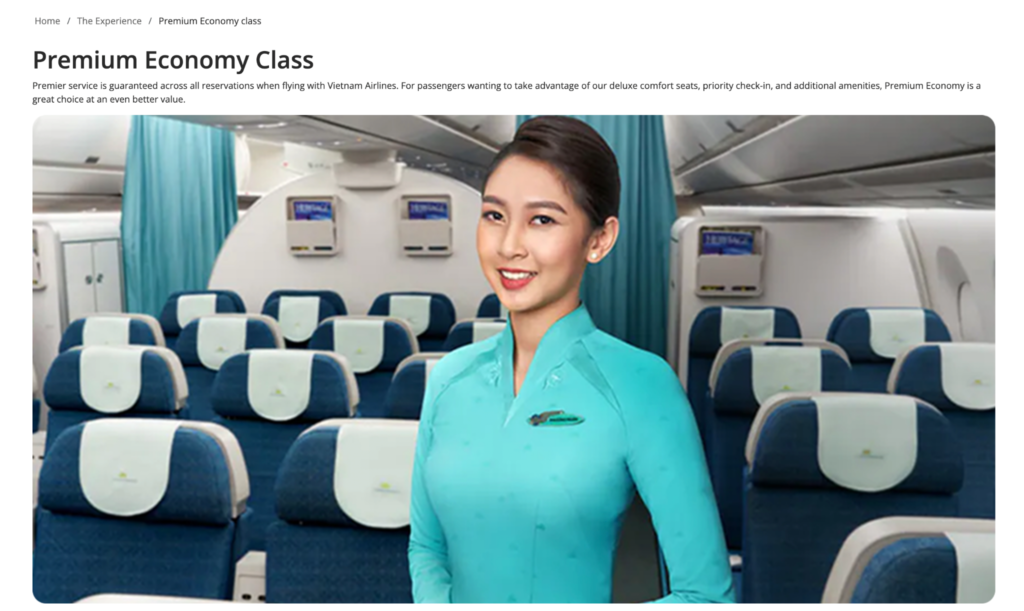
Premium Economy is one of the more interesting Vietnam Airlines products for travelers who want noticeably better comfort without paying Business Class prices.
It is particularly relevant on longer international routes.
The biggest advantage is space. Passengers generally receive a wider seat, more legroom, greater recline, and a smaller, less crowded cabin than standard Economy.
Premium Economy can also provide additional service benefits depending on the route and ticket.
| Cabin | Typical Comfort Level | Seat Pitch* | Seat Width* | Best For |
| Economy | Standard | Around 31–32 in | Around 17–18 in | Budget-conscious travelers |
| Premium Economy | Very Good | Around 38–42 in | Around 18–19 in | Long-haul leisure travelers |
| Business Class | Excellent | Flat-bed capable on key long-haul aircraft | Around 20–22+ in | Business and premium travelers |
Business Class
Vietnam Airlines Business Class is where the airline’s modern long-haul fleet makes the biggest impression. On key international routes operated by the Boeing 787 Dreamliner and Airbus A350, Business Class offers a considerably more premium experience than the airline’s regional Economy product might lead you to expect.
The main attraction is the fully flat bed available on many long-haul aircraft. This matters enormously on overnight flights between Vietnam and destinations in Europe, Australia, or Northeast Asia. Being able to turn your seat into a proper flat sleeping surface can make the difference between arriving exhausted and arriving reasonably rested.
Storage space is reasonable, with areas for phones, headphones, small electronics, and personal items. Power outlets and USB charging are available on many long-haul configurations.
Business Class passengers can typically expect:
- Fully flat or lie-flat seating on key long-haul aircraft
- Direct aisle access on many Boeing 787 and Airbus A350 configurations
- Larger personal entertainment screens
- Premium pillows and blankets
- Enhanced meal service
- Priority check-in
- Priority boarding
- Additional baggage benefits
- Lounge access where eligible
- Priority baggage handling
- Amenity kits on selected long-haul services
Privacy is good rather than exceptional. Vietnam Airlines does not generally compete with newer Business Class products that use fully enclosed suites with sliding doors. Instead, its product focuses on the fundamentals: a comfortable flat bed, personal space, direct aisle access, good food, and professional service.
For business travelers, those fundamentals may matter more than flashy cabin design.
In-Flight Entertainment & Connectivity
In-flight entertainment varies considerably depending on the aircraft.
On newer long-haul aircraft such as the Boeing 787 and Airbus A350, the experience is significantly better than on aircraft used for shorter domestic and regional services.
Passengers in equipped cabins receive personal entertainment screens offering a selection of international and Vietnamese content.
Entertainment Selection
The entertainment library typically includes a mixture of:
- International movies
- Vietnamese movies
- Asian cinema
- Television programs
- Children’s entertainment
- Music
- Games
- Flight information
- Moving maps
For international passengers, there is enough English-language content to make a long journey more manageable. However, travelers accustomed to the enormous entertainment libraries offered by airlines such as Emirates or Singapore Airlines may find Vietnam Airlines’ selection less extensive.
That does not make the system poor. It simply means entertainment is functional rather than one of the airline’s strongest competitive advantages.
Screen size also depends on the cabin.
Business Class receives the largest screens, followed by Premium Economy and Economy. On newer aircraft, image quality is generally good enough for movies and television during long-haul flights.
Touch responsiveness can vary slightly depending on the specific entertainment system and aircraft. A handheld controller may also be available, which can be more convenient when the screen is positioned farther away in Business Class.
Wi-Fi Availability
Connectivity is an area where passengers should manage expectations.
Vietnam Airlines has been developing and expanding connectivity options, but Wi-Fi availability can depend heavily on the aircraft and route. Travelers should not automatically assume that every Vietnam Airlines flight will offer internet access.
If staying connected is essential for work, check the services available on your particular aircraft before departure.
This is especially important for business travelers planning to use several hours of flying time for emails, cloud-based work, or video calls.
Even when connectivity is available, airline Wi-Fi should generally be treated as useful for messaging, email, browsing, and light work rather than as a replacement for a fast home or office connection.
Dining & Food Quality
Food is one area where Vietnam Airlines has an opportunity to show its identity as the country’s flag carrier.
Instead of relying entirely on generic international airline meals, Vietnam Airlines incorporates Vietnamese flavors into parts of its onboard catering.
That is particularly noticeable in premium cabins.
Passengers may encounter dishes inspired by Vietnamese cuisine alongside Western and other Asian choices. Depending on the departure airport, flight duration, cabin, and time of day, the menu can change considerably.
Asian vs. Western Meals
If you enjoy Asian food, I would generally lean toward the Vietnamese or Asian option when one is available.
Vietnamese cuisine works surprisingly well in an aircraft environment because many dishes rely on rice, noodles, broth, vegetables, herbs, and slow-cooked meats rather than foods that need to remain crispy.
Western meals are also offered on many international routes and can include combinations such as chicken, beef, pasta, potatoes, salads, bread, and desserts.
Economy meals are naturally simpler. On long-haul services, passengers can typically expect a tray-based meal with a main dish, side items, bread or another accompaniment, dessert, and drinks.
Business Class takes a more restaurant-style approach, with courses presented individually or in a more refined format.
Sample Vietnam Airlines Business Class Menu
The exact menu changes by route, season, departure airport, and catering arrangements, but a representative long-haul Business Class meal could look like this:
| Course | Sample Selection |
| Starter | Smoked salmon or Vietnamese-style appetizer with fresh salad |
| Main Course | Vietnamese beef with rice and vegetables, grilled fish, or Western-style chicken |
| Dessert | Fresh fruit, cake, cheese, or seasonal dessert |
| Hot Drink | Vietnamese coffee or tea |
| Other Beverages | Juice, soft drinks, wine and selected alcoholic beverages |
One of the more enjoyable choices is Vietnamese coffee. For international visitors, having Vietnamese-style coffee onboard adds a small but memorable local touch to the experience.
Tea is another natural part of the beverage service, including selections that complement the airline’s Vietnamese identity.
Special Meals
Passengers with dietary or religious requirements can request special meals on eligible flights.
Depending on the route and availability, these can include:
- Vegetarian meals
- Vegan meals
- Asian vegetarian meals
- Muslim/Halal-oriented meal options
- Low-calorie meals
- Low-salt meals
- Diabetic-friendly meals
- Children’s meals
- Infant meals
- Other medically or religiously appropriate meals
Special meals normally need to be requested before departure rather than onboard.
Safety and Overall Aircraft Comfort
Safety is naturally one of the biggest concerns when choosing an unfamiliar international airline.
Vietnam Airlines operates under international commercial aviation standards and serves major regulated aviation markets across Asia, Europe, and Australia. Its membership in SkyTeam also places it within an international airline ecosystem where operational coordination and safety standards are important.
The modern 787 and A350 fleets further strengthen the airline’s long-haul operation.
For passengers, however, aircraft comfort is often more immediately noticeable than technical specifications.
The combination of quieter cabins, modern lighting, improved air systems, better overhead storage, and lower cabin altitude can make a meaningful difference on a long journey.
Baggage Policy & Allowance
Baggage is one area where Vietnam Airlines can offer a meaningful advantage over low-cost carriers, particularly for travelers taking longer trips or traveling internationally.
With a budget airline, the advertised fare can look very attractive until checked baggage, seat selection, food, and other extras are added. Vietnam Airlines follows a more traditional full-service model, although the exact baggage allowance depends on the fare, cabin, route, and ticket conditions.
This means you should never assume that two Economy tickets automatically include the same baggage allowance.
Carry-On Baggage
Vietnam Airlines’ cabin baggage rules vary according to travel class and itinerary. Economy passengers generally receive a lower allowance than Premium Economy and Business Class travelers.
Your cabin baggage can typically consist of a main carry-on item plus eligible smaller personal items, subject to the total weight and size limits attached to your ticket.
A practical overview looks like this:
| Cabin Class | Cabin Baggage | Checked Baggage | Best For |
| Economy | Standard allowance based on fare/route | Varies by fare and route | Regular leisure travel |
| Premium Economy | Higher allowance on eligible routes | Generally more generous | Long-haul travelers |
| Business Class | Most generous cabin allowance | Higher checked allowance | Business and premium travel |
Because Vietnam Airlines can apply different baggage rules depending on the origin and destination, always check the baggage allowance displayed on your actual ticket.
Checked Baggage
Checked baggage is where Vietnam Airlines becomes particularly attractive for international travelers.
Many eligible full-service fares include checked baggage, while passengers purchasing higher cabin classes typically receive more generous allowances.
The specific system can be based on weight or individual pieces depending on the route and ticket.
Before heading to the airport, check:
- Number of checked bags included
- Maximum permitted weight per bag
- Maximum dimensions
- Cabin baggage allowance
- Excess baggage charges
- Rules for sports equipment
- Infant baggage allowance
- Restrictions on batteries and electronic devices
Do not rely on an allowance you received on a previous Vietnam Airlines flight. Your next itinerary could have different rules.
Excess and Special Baggage
If you know you will exceed your standard allowance, arranging additional baggage before arriving at the airport can be easier than dealing with the issue at check-in.
Vietnam Airlines also has procedures for items such as sporting equipment, oversized baggage, wheelchairs, and other special items.
Golfers, students, families relocating internationally, and passengers carrying substantial luggage should check these rules before purchasing a ticket.
For an Economy passenger traveling with a normal suitcase and carry-on, however, the full-service baggage model is generally much simpler than building a low-cost fare piece by piece.
Lotusmiles Program
Frequent Vietnam Airlines passengers should take a closer look at Lotusmiles, the airline’s loyalty program.
Lotusmiles allows members to earn miles from eligible Vietnam Airlines flights and participating partners. Vietnam Airlines’ SkyTeam membership makes the program more useful for passengers who regularly travel internationally.
You do not necessarily need to fly only with Vietnam Airlines to benefit.
Depending on the fare and partnership rules, eligible travel with participating airlines can contribute toward your loyalty activity.
Lotusmiles Membership Tiers
Lotusmiles has multiple membership levels, with benefits becoming more valuable as you progress through the program.
The structure includes entry-level membership and progressively higher elite tiers.
| Lotusmiles Level | Typical Traveler | Main Value |
| Registered | New member | Start earning and redeeming miles |
| Silver | Occasional traveler | Entry into the tier structure |
| Titanium | Regular traveler | Additional priority benefits |
| Gold | Frequent flyer | Stronger airport and travel privileges |
| Platinum | Very frequent traveler | Highest level of premium benefits |
Exact qualification requirements and individual benefits can change, so frequent flyers should check the current Lotusmiles rules when planning their status strategy.
Vietnam Airlines vs Competitors
Vietnam Airlines vs Singapore Airlines
Singapore Airlines represents a much tougher premium comparison.
Singapore Airlines has built an exceptional global reputation around cabin service, premium seating, lounges, catering, and in-flight entertainment.
If both airlines cost exactly the same and offered equally convenient nonstop schedules, I would generally consider Singapore Airlines the more polished premium product.
But real-world flight shopping rarely works like that.
This is where value becomes important.
A slightly less luxurious airline operating a convenient nonstop flight at a significantly lower price may be the smarter purchase.
Vietnam Airlines vs Thai Airways
Thai Airways International is another useful comparison because both are major Southeast Asian full-service airlines.
Both offer Economy and premium cabins, international connections, lounges, meals, checked baggage on eligible fares, and wide-body aircraft.
The better airline often depends more on your itinerary than on a simple service ranking.
Passengers traveling primarily to Vietnam naturally benefit from Vietnam Airlines’ domestic connectivity.
Travelers connecting extensively through Bangkok may find Thai Airways more convenient.
Pros & Cons of Vietnam Airlines
No airline is perfect, and Vietnam Airlines has clear strengths as well as areas where competitors can do better.
Pros
- Strong domestic network: Excellent choice for travelers visiting multiple destinations in Vietnam.
- Modern long-haul aircraft: Boeing 787 Dreamliners and Airbus A350s provide a comfortable international flying experience.
- Good Business Class fundamentals: Flat-bed seats and direct aisle access on key wide-body configurations make long journeys much easier.
- Premium Economy option: A useful middle ground for travelers who need more comfort but cannot justify Business Class.
Cons
- Digital experience could be better: The website and app are functional but may not feel as refined as those of some premium international competitors.
- Wi-Fi is not consistently available: Connectivity depends on the aircraft and route.
- Entertainment selection varies: The library may feel limited compared with airlines known for huge entertainment catalogs.
- Experience depends on aircraft: A newer A350 or 787 can provide a substantially different experience from aircraft operating shorter routes.
Final Verdict: Is Vietnam Airlines Worth It?
After looking at the complete experience, Vietnam Airlines makes the most sense when you judge it for what it is: Vietnam’s full-service flag carrier with a strong domestic network and a genuinely competitive modern long-haul product.
It is not trying to beat VietJet at ultra-low fares.
It also does not consistently deliver the extravagant premium experience associated with the world’s most luxurious airlines.
Instead, Vietnam Airlines occupies a useful middle ground.
For Economy passengers, the attraction is convenience. You get a traditional full-service experience, strong connectivity within Vietnam, and potentially fewer extras to purchase separately.
For Premium Economy passengers, Vietnam Airlines becomes even more interesting. The additional space can significantly improve a long flight without requiring the substantial jump in price associated with Business Class.
And Business Class is arguably where the airline offers its strongest value proposition. On the right Boeing 787 or Airbus A350 flight, you can get a flat bed, direct aisle access, lounge access, priority airport services, premium dining, and a comfortable modern cabin.