
Finding a hotel is easy. Finding the right hotel at the lowest genuine price is where things get messy.
The best hotel booking websites often display the same property, the same room type, and what appears to be the same cancellation policy. Yet the final amount can be different once taxes, service charges, breakfast, payment conditions, and currency-conversion costs are included.
That is why choosing a booking website based only on the first price you see is a bad strategy.
Some platforms are strongest for cheap hotels in Asia. Others work better for package holidays, business trips, family apartments, loyalty rewards, or last-minute bookings. A website that saves one traveller $40 could cost another traveller more because of a restrictive cancellation policy.
Here’s the truth about hotel booking sites: there is no single platform that offers the lowest rate for every hotel, destination, and travel date.
The smarter approach is to know which platform is most likely to work for your specific trip.
For this list of the 8 best hotel booking websites, I looked beyond flashy discount labels. I focused on the things that actually affect the booking experience:
- The final price after mandatory charges
- Hotel and room selection
- Cancellation flexibility
- Search filters and usability
- Loyalty benefits
- Mobile app experience
- Customer support
- Reliability when a booking goes wrong
This article is not about declaring every major travel website “excellent.” Some are excellent for searching but frustrating when you need a refund. Some show impressive discounts that disappear when you change the payment method. Others offer strong rewards but only if you keep booking through the same travel group.
Below, I will explain exactly where each website performs well, where it falls short, and who should use it.
How I Selected the Best Hotel Booking Websites
A hotel booking platform should do more than display a large number of properties. Huge inventory is useful, but it means very little when the search results are confusing or the final price is higher than expected.
I judged each platform using three main areas.
1. Price and Overall Value
I looked at more than the headline room rate. A genuinely good deal should account for taxes, booking fees, breakfast, cancellation terms, payment timing, and loyalty rewards.
A non-refundable room that costs $8 less is not necessarily better value. The risk of losing the entire payment may outweigh the small saving.
I also considered whether the platform offers meaningful member prices, cashback, app discounts, or rewards that can realistically be used.
2. Ease of Use
The best hotel booking websites should make comparison simple. Useful filters include:
- Total price
- Guest rating
- Neighbourhood
- Distance from landmarks
- Free cancellation
- Breakfast included
- Property type
- Bed configuration
- Accessibility features
- Pay-at-property options
I gave higher marks to websites that clearly explain room conditions before payment rather than hiding them behind several menus.
3. Customer Support and Booking Reliability
Most booking sites work perfectly when the trip goes as planned. Their real quality becomes clear when the hotel cannot find the reservation, a refund is delayed, or the property is nothing like the listing.
I considered the availability of phone and chat support, booking-management tools, cancellation assistance, and the platform’s willingness to step in when there is a dispute.
No third-party booking website can fully control a hotel. Still, some platforms are much easier to deal with than others.
1. Booking.com: Best Overall Hotel Booking Website
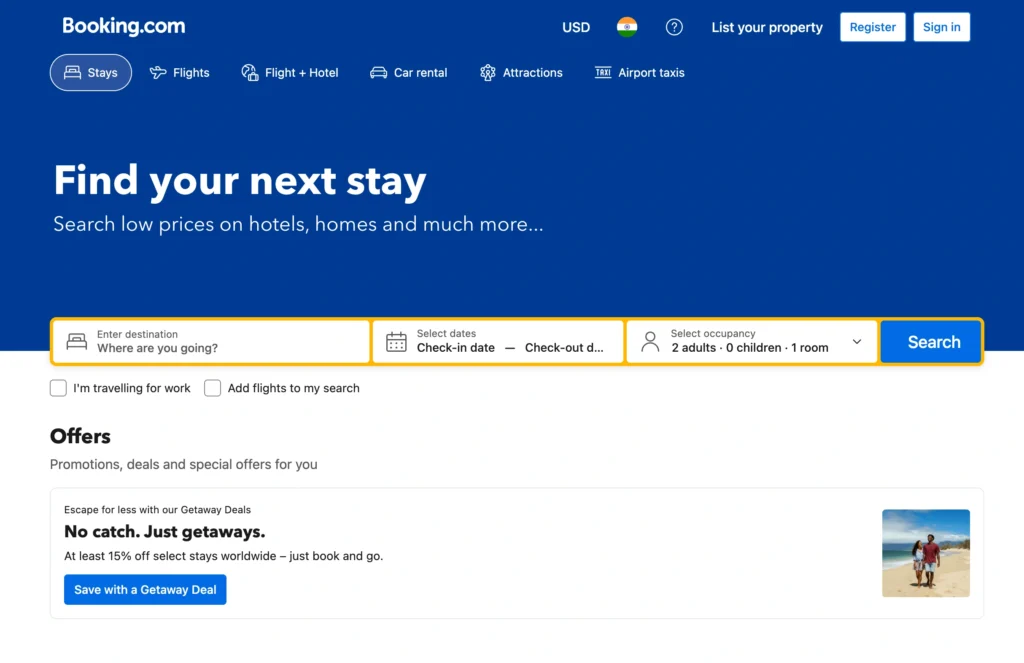
Booking.com is the safest starting point for most travellers. It has a massive selection covering major hotel chains, independent hotels, apartments, hostels, guesthouses, resorts, and unusual stays.
Its biggest strength is not always having the absolute lowest price. It is the combination of inventory, strong filters, detailed property information, and flexible booking options.
You can quickly filter for free cancellation, breakfast, guest rating, distance from the city centre, property type, and payment conditions. The map view is also genuinely useful when location matters more than hotel branding.
Booking.com’s Genius programme adds another layer of value. Creating a free account unlocks Genius Level 1, which offers 10% discounts at participating properties. Travellers can reach higher levels by completing qualifying bookings within a two-year period, unlocking larger discounts and selected perks.
Best for
- Travellers who want the widest selection
- First-time international travellers
- Families needing apartments or larger rooms
- People who prefer free cancellation
- Travellers comparing several neighbourhoods
The Standout Feature
Booking.com has one of the best combinations of search depth and booking flexibility.
The room-selection page usually gives you several versions of the same room. You may see a cheaper non-refundable option, a flexible option, a breakfast-inclusive rate, and a pay-later rate.
That makes it easier to choose based on risk, not just price.
The Catch
The search page can feel overloaded. There are discount badges, limited-availability messages, Genius labels, mobile prices, sponsored listings, and multiple room conditions competing for attention.
You must also check whether taxes and charges are included in the displayed amount. This can vary by destination and local regulations.
Customer support quality can depend on the specific booking and hotel. Booking.com may act as the intermediary, but the property’s own cancellation terms still carry significant weight.
Pros
- Huge global inventory
- Excellent search filters
- Strong selection of apartments and independent stays
- Many free-cancellation options
- Useful verified guest reviews
- Immediate entry into the Genius programme
Cons
- Search pages can feel cluttered
- Final prices require careful checking
- Not every Genius property offers the same benefits
- Third-party bookings may not earn hotel-chain loyalty points
Price/Value Rating: 9.2/10
Pick Booking.com when you want the most balanced hotel booking experience. It may not win every price comparison, but it is the platform I would trust for the broadest range of trips.
2. Agoda: Best for Cheap Hotels in Asia
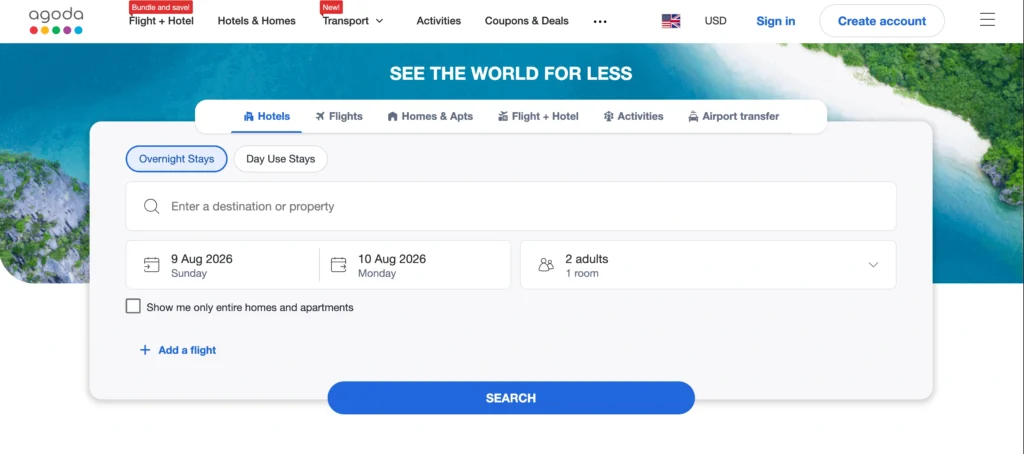
If you’re travelling around Thailand, Vietnam, Malaysia, Indonesia, Japan, South Korea, or other parts of Asia, Agoda should be one of the first websites you check.
Agoda often has particularly strong rates for Asian hotels, including budget properties, beach resorts, city hotels, and locally operated accommodation that may receive less visibility on Western-focused platforms.
The interface is built around promotions. You will regularly see app-only rates, member deals, limited-time discounts, cashback offers, AgodaCash, and VIP prices.
AgodaCash can be awarded on selected reservations and used as a discount on future bookings. The platform also offers PointsMAX on eligible stays, allowing customers to earn rewards with selected external loyalty programmes.
Best for
- Budget travellers visiting Asia
- Backpackers
- Travellers booking Asian beach resorts
- Mobile users looking for app discounts
- Frequent Agoda customers who can reuse rewards
The Standout Feature
Agoda can produce surprisingly low prices in Asian markets.
In destinations such as Bangkok, Kuala Lumpur, Bali, Hanoi, Manila, and Tokyo, Agoda is often highly competitive. It may also show more locally relevant room plans or promotions than some international competitors.
Its app is worth checking separately because app pricing can differ from desktop pricing.
The Catch
Agoda’s pricing presentation can be confusing.
A deal may involve cashback received later rather than an immediate reduction. Some promotions apply only to selected payment methods, room types, or future bookings. The cheapest rate may also have strict cancellation conditions.
Do not assume every crossed-out price represents a realistic market price. Focus on the final payable amount and compare it against the hotel’s own website.
Support can also become frustrating when a reservation involves several parties, such as Agoda, a wholesale supplier, and the hotel itself.
Pros
- Frequently strong hotel rates in Asia
- Wide selection of budget and mid-range properties
- Useful mobile-only offers
- AgodaCash and PointsMAX rewards
- Good coverage of smaller independent hotels
- Plenty of pay-now and pay-later choices
Cons
- Discount structure can be difficult to understand
- Cashback may not be immediate
- Taxes and fees can change the apparent saving
- Cancellation rules require close attention
- Complex bookings may be harder to resolve
Price/Value Rating: 9.0/10
Pick Agoda for Asian destinations, but read every pricing condition before paying. It is one of the best hotel booking websites for finding a bargain, though not always the easiest for understanding how that bargain works.
3. Expedia: Best for Hotel and Flight Packages
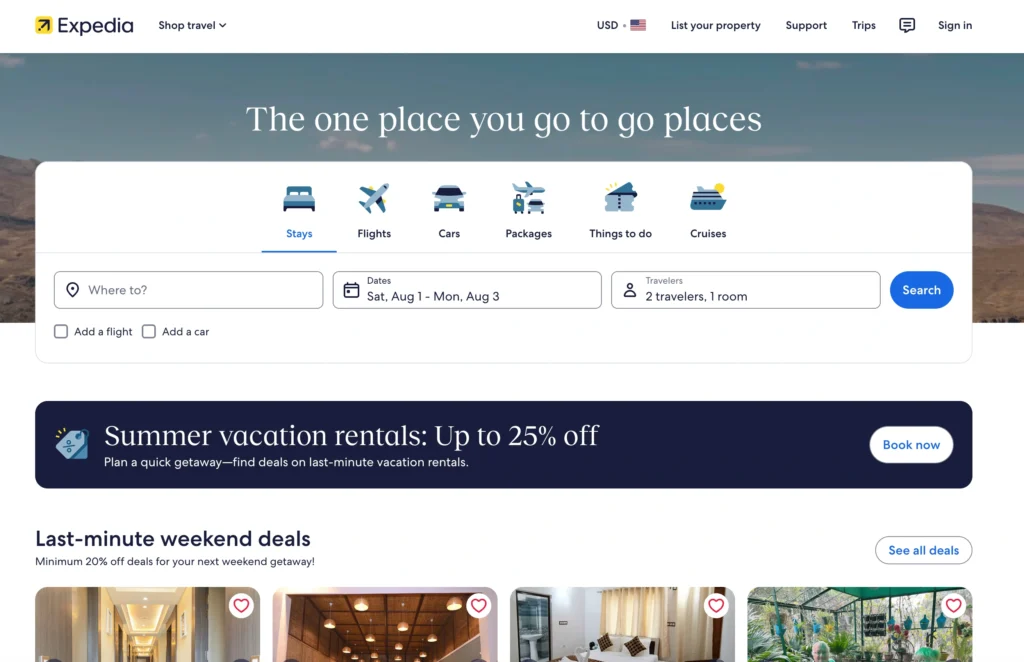
Expedia makes the most sense when the hotel is only one part of your trip.
You can book flights, hotels, car rentals, activities, cruises, and holiday packages from the same account. That makes it particularly useful for travellers who would rather manage an entire holiday in one place than use separate websites for each component.
Expedia frequently encourages users to combine a hotel with a flight or car rental. Package rates can sometimes beat the cost of booking each part separately, although this should never be assumed without comparing the totals.
Its One Key rewards programme provides member prices and OneKeyCash on eligible bookings. Entry-level members can access discounts of 10% or more at a large selection of participating hotels, while higher tiers can unlock larger member discounts.
Best for
- Travellers booking flights and hotels together
- Families planning complete holidays
- Road trips involving hotels and car rentals
- Travellers who prefer one booking account
- Existing One Key members
The Standout Feature
Expedia is one of the strongest platforms for assembling a complete trip.
The ability to connect flights, hotels, transport, and activities can reduce planning time. It also gives package travellers access to deals that may not appear when booking the hotel alone.
The app provides a reasonably clear itinerary view, which is helpful when several reservations are involved.
The Catch
Package savings are inconsistent.
Sometimes Expedia offers a genuinely strong bundled price. Other times, the hotel rate is similar to Booking.com or the property’s direct website, while the flight may be cheaper elsewhere.
Package bookings can also be more difficult to change. Altering one component may affect the price or terms of the others.
Expedia is less appealing when you only need a simple one-night hotel stay and have no interest in its wider travel ecosystem.
Pros
- Excellent for flight-and-hotel packages
- Hotels, cars, activities, and flights in one place
- One Key member prices
- Easy itinerary management
- Good selection in North America and major destinations
- Useful filters for families and resort stays
Cons
- Package changes can become complicated
- Standalone hotel rates are not always the cheapest
- Rewards apply only to eligible bookings
- Hotel-chain points and status benefits may not apply
Price/Value Rating: 8.7/10
Pick Expedia when you are booking several parts of the same trip. For hotel-only reservations, compare it with Booking.com and the hotel’s direct rate before committing.
4. Hotels.com: Best for Hotel-Focused Reward Seekers
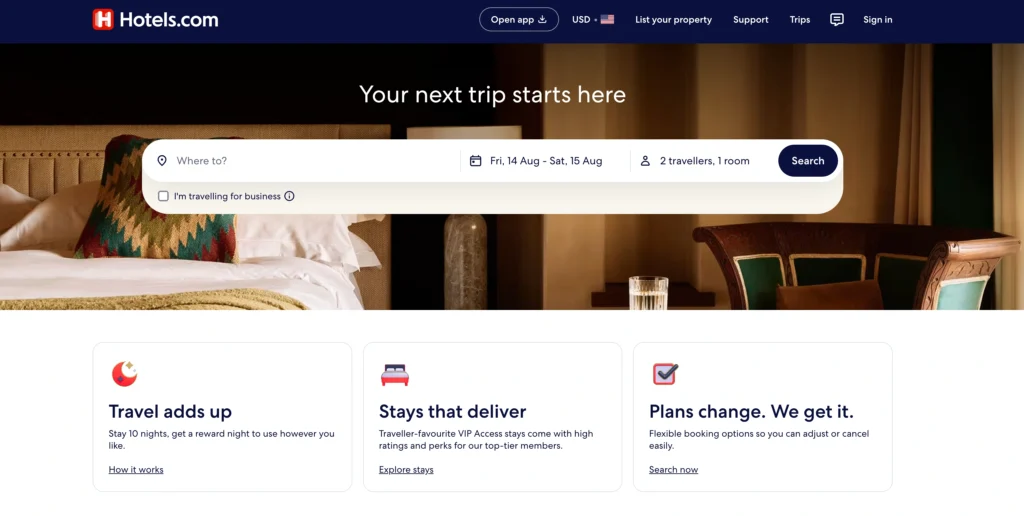
Hotels.com does exactly what its name suggests. It focuses heavily on accommodation, making it simpler than all-in-one travel websites for travellers who mainly want a hotel.
Its search interface is clean, familiar, and easy to filter. You can compare hotels, resorts, apartments, and holiday homes without being pushed as aggressively towards flights, cruises, and other travel products.
Hotels.com has historically been known for its hotel rewards, although its loyalty structure has changed across markets. In many locations, it has operated under Expedia Group’s One Key programme, where eligible bookings generate OneKeyCash that can be used on future stays. Hotels.com currently advertises the ability to earn up to 6% on qualifying trips, depending on membership level and booking conditions.
Because reward structures can differ by country and may change, check the programme shown in your account before booking.
Best for
- Travellers who mainly book hotels
- Existing Hotels.com reward members
- Regular city-break travellers
- People who prefer a cleaner search experience
- Expedia Group customers using One Key
The Standout Feature
Hotels.com makes repeat hotel booking straightforward.
The platform feels less crowded than some competitors. Property pages are generally easy to scan, and filters cover the details most travellers need, including neighbourhood, guest rating, amenities, property type, and cancellation options.
Rewards can offer useful value for people who book frequently and remain within the Hotels.com ecosystem.
The Catch
Hotels.com has lost some of the uniqueness it once had.
Its earlier reward model was extremely easy to understand: book ten eligible nights and receive a reward night based on their average value. In markets where One Key replaced that system, some loyal customers found the new earning structure less generous or less intuitive.
There can also be substantial overlap between Hotels.com and Expedia because both belong to the same travel group. You may see similar inventory, prices, and conditions on both platforms.
Pros
- Hotel-focused interface
- Easy search and comparison tools
- Member-only rates
- Rewards on eligible bookings
- Strong inventory in popular destinations
- Simple booking management
Cons
- Loyalty benefits vary by market
- Considerable overlap with Expedia
- Rewards may be less valuable on cheaper stays
- Direct hotel benefits may not be recognised
- Not the strongest option for complete travel packages
Price/Value Rating: 8.4/10
Pick Hotels.com when you want a straightforward, hotel-first experience and its current rewards programme suits your travel habits. Expedia is usually better for packages, while Hotels.com feels cleaner for accommodation-only bookings.
5. Trip.com: Best for Travellers Booking Across Asia
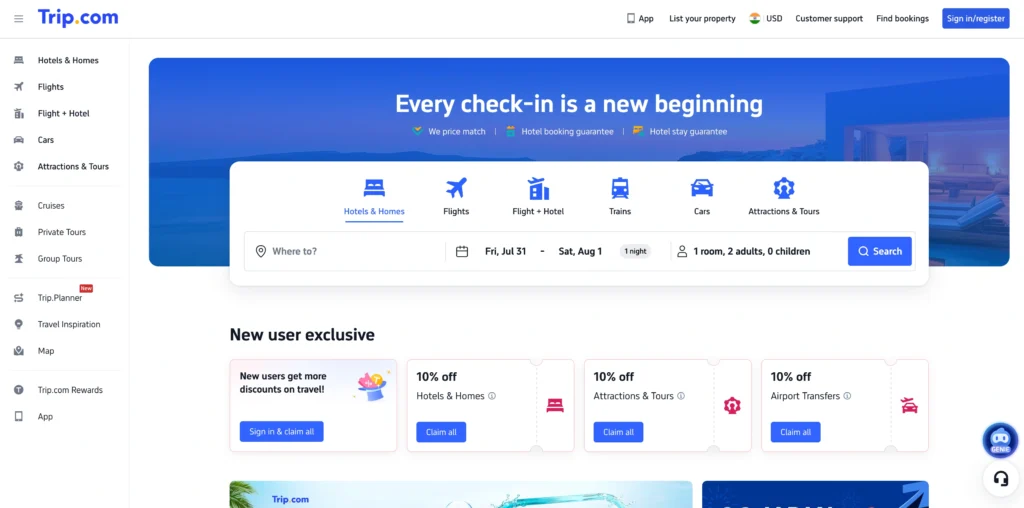
Trip.com has developed into a serious global booking platform, but its strongest use case remains travel involving Asia.
It offers hotels, flights, trains, airport transfers, attractions, car rentals, and packages. This makes it particularly convenient for travellers moving through destinations where hotel bookings, domestic flights, and high-speed rail tickets may all be required.
The platform has a tiered membership programme with hotel member deals and Trip Coins. Coins earned from eligible bookings can be used like cash on supported prepaid travel products. Higher membership tiers earn coins at increased rates and may receive additional travel perks.
Best for
- Multi-city trips around Asia
- Travellers booking hotels and trains together
- Visitors to China, Japan, South Korea, and Southeast Asia
- App-based travellers
- Users who value 24/7 support access
The Standout Feature
Trip.com is strong at connecting multiple parts of an Asian itinerary.
A traveller visiting Shanghai, Seoul, Tokyo, or Bangkok can book accommodation, transport, and selected activities through one platform. Its train-booking coverage gives it an advantage over many hotel-first competitors.
Trip.com also promotes 24/7 chat and phone support, emergency assistance, and service guarantees for certain booking problems.
The Catch
The platform can feel promotion-heavy. Coupons, Trip Coins, tier benefits, app prices, and package offers make it harder to determine whether you are receiving a real discount or simply a differently structured price.
Trip Coins are useful only when you continue using eligible Trip.com services. They should not be treated as an immediate cash saving unless you already expect to make another booking.
Hotel coverage is global, but Trip.com may not be the natural first choice for a basic domestic hotel booking in markets where Booking.com or Expedia has stronger familiarity and support infrastructure.
Pros
- Strong coverage across Asia
- Hotels, flights, trains, and attractions in one app
- Trip Coins for eligible bookings
- Tiered member benefits
- 24/7 support through phone and chat
- Useful for complicated multi-city itineraries
Cons
- Rewards and promotions can feel complicated
- Coins encourage repeat spending
- Not always the cheapest for Western destinations
- Some benefits depend on membership tier
- Room and cancellation details must be checked carefully
Price/Value Rating: 8.6/10
Pick Trip.com when your journey involves several Asian destinations or different types of transport. For a simple hotel-only booking, it is still worth comparing, but its biggest advantage is itinerary convenience rather than guaranteed lowest pricing.
Here is Part 2, covering the remaining three hotel booking websites, comparison table, FAQs, and final verdict.
6. HotelsCombined: Best for Comparing Prices Across Multiple Websites
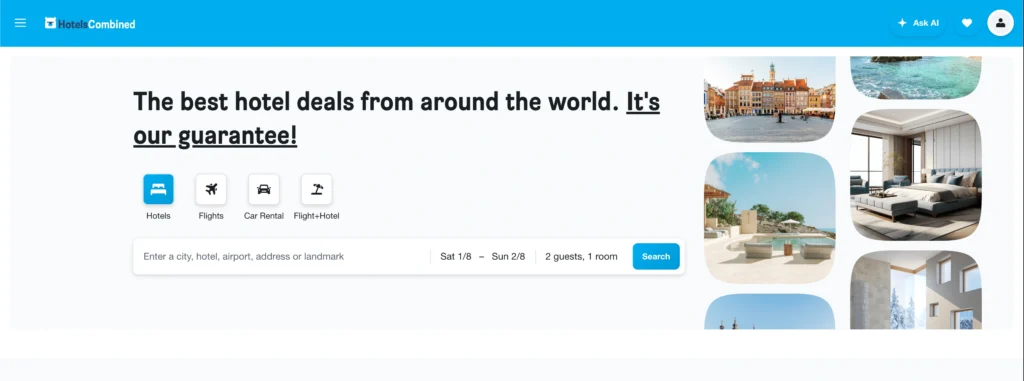
HotelsCombined is not a traditional hotel booking website in the same way as Booking.com or Agoda. It is a metasearch engine, which means it compares hotel prices from several booking platforms and sends you to another website to complete the reservation.
That makes it useful during the research stage.
Instead of opening Booking.com, Agoda, Expedia, Trip.com, and several smaller sites one by one, you can search once and see a range of available rates.
The value is simple: HotelsCombined helps you find price differences that would otherwise be easy to miss.
Best for
- Price-sensitive travellers
- People who like comparing several platforms
- Travellers booking expensive or long stays
- Users who already understand third-party booking conditions
- Anyone looking for a quick market-price check
The Standout Feature
HotelsCombined saves time by placing offers from different booking providers on one results page.
This is especially useful when the same hotel appears at noticeably different prices across multiple websites. Even a small nightly difference matters when you are staying for a week.
The map and filtering tools also help you narrow the results by location, star rating, guest score, property type, and amenities.
HotelsCombined can also reveal lesser-known booking providers. These sites sometimes offer lower prices than the major platforms, although using them may involve additional risk.
The Catch
HotelsCombined does not control the final booking.
Once you select an offer, you are redirected to the booking provider. That provider handles your payment, cancellation, refund, and customer-service requests.
This is where people get caught out.
A cheap offer from an unfamiliar website may have weak customer support, strict cancellation terms, or a final price that changes during checkout. The rate shown on the comparison page may also disappear if availability changes.
You must judge both the hotel and the booking provider.
HotelsCombined is excellent for finding rates, but it is not always the best place to begin a booking you expect to modify later.
Pros
- Compares prices from multiple booking websites
- Saves time during hotel research
- Useful for spotting unusually low rates
- Strong map and filtering tools
- Good for longer or more expensive stays
- Helps establish the normal market price
Cons
- Does not directly manage most bookings
- Customer support depends on the selected provider
- Some lesser-known booking sites carry more risk
- The displayed rate may change during checkout
- Cancellation policies vary widely
Price/Value Rating: 8.5/10
Pick HotelsCombined when your main goal is to compare prices quickly. Use it as a discovery tool, then investigate the final booking provider before paying.
7. Priceline: Best for Flexible Travellers Seeking Deep Discounts
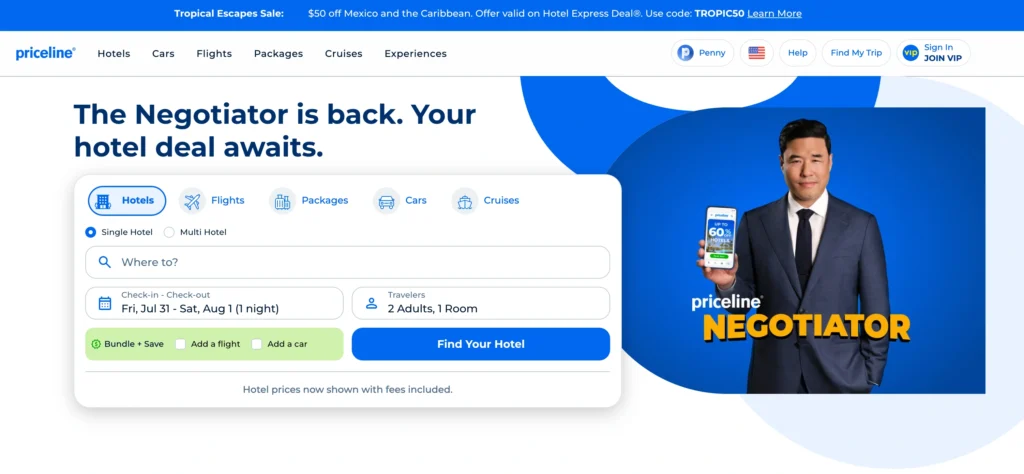
Priceline has been part of the online travel industry for years. It sells hotels, flights, rental cars, cruises, and holiday packages, but it remains best known for discount-oriented hotel deals.
The platform is particularly interesting for travellers who care more about price than choosing a specific hotel.
Priceline’s Express Deals may hide the hotel’s name until after payment. You normally see the approximate area, star rating, guest score, and amenities before booking, but the exact property is revealed only after the reservation is confirmed.
That lack of certainty allows Priceline to offer lower rates on selected rooms.
Best for
- Flexible travellers
- Last-minute city stays
- Couples taking short trips
- Travellers who prioritise price over hotel branding
- People comfortable with non-refundable reservations
The Standout Feature
Priceline can offer deep discounts when you accept limited information before booking.
Express Deals work best in areas where several hotels have similar standards. For example, if you only need a well-rated four-star property near an airport or convention centre, the exact hotel name may not matter much.
Priceline also offers VIP member rates. Creating an account can unlock additional hotel discounts, with higher membership levels offering broader benefits to frequent users.
The platform is especially relevant in the United States, where its hotel inventory and discount products tend to be strongest.
The Catch
The best Priceline deals often require commitment.
Express Deals are usually restrictive and may be non-refundable. Once the hotel is revealed, you generally cannot cancel simply because you dislike the property or location.
The listed neighbourhood can also cover a fairly large area. A hotel described as being near a city centre may still require a taxi or public transport ride.
Priceline is a poor choice when you need a specific bed type, guaranteed accessibility features, a precise street location, or flexible cancellation.
Its regular hotel rates can also be similar to those on Expedia or Booking.com, so the platform becomes most valuable when its special discount formats are available.
Pros
- Strong discount potential
- Useful Express Deals
- VIP member pricing
- Good inventory in the United States
- Suitable for spontaneous trips
- Hotels, flights, and cars available together
Cons
- Discount bookings may hide the hotel name
- Many special rates are non-refundable
- Location zones can be broad
- Not ideal for families with precise room needs
- Standard rates are not always remarkable
Price/Value Rating: 8.3/10
Pick Priceline when you are flexible about the exact hotel and willing to accept stricter conditions for a lower price. Avoid its mystery-style offers when the property itself is an important part of the trip.
8. Google Hotels: Best for Fast Research and Direct Price Comparison
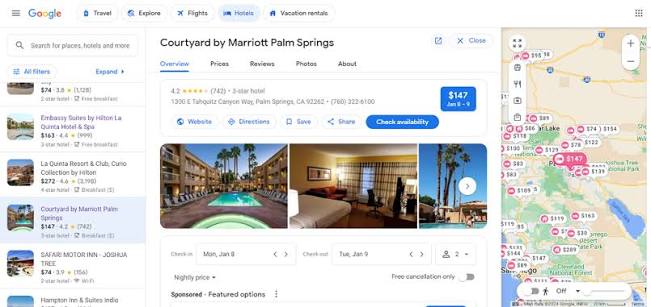
Google Hotels is one of the quickest tools for understanding the hotel market in a destination.
Search for hotels in a city through Google, and you can compare properties using an interactive map, dates, prices, ratings, amenities, and location filters. Selecting a hotel usually displays rates from several booking platforms alongside the hotel’s direct website.
Google Hotels does not function like a normal online travel agency. It mainly helps users discover and compare options before sending them elsewhere to complete the booking.
That difference is important.
You do not earn a Google Hotels loyalty reward, and Google usually does not handle your reservation if something goes wrong. The booking provider remains responsible.
Best for
- Travellers beginning their hotel search
- People comparing direct and third-party prices
- Visual travellers who prefer map-based research
- Anyone checking whether a discount is genuine
- Travellers deciding between neighbourhoods
The Standout Feature
Google Hotels gives you a clear view of price, location, and availability without locking you into one booking platform.
The map makes it easy to understand how close a property is to train stations, airports, tourist areas, beaches, or business districts.
You can also compare the hotel’s direct rate against offers from online travel agencies. This matters because direct booking may include benefits such as breakfast, flexible cancellation, loyalty points, free parking, room upgrades, or easier communication with the hotel.
Google’s date tools may also indicate when hotel prices are higher or lower than usual. This can help flexible travellers select cheaper travel dates.
The Catch
Google Hotels is a search tool, not a protective layer.
Some of the lowest rates may come from booking providers you have never heard of. A low price does not mean the provider is reliable.
Sponsored results can also receive prominent placement. The cheapest visible option is not automatically the best overall choice.
Another issue is rate consistency. A price displayed by Google may change when you reach the booking page because of taxes, currency changes, room availability, or outdated information.
Google Hotels is excellent for research, but the final decision still requires careful checking.
Pros
- Fast hotel price comparison
- Excellent map-based search
- Shows direct hotel rates
- Useful date and location tools
- No need to search every platform separately
- Good for comparing neighbourhoods
Cons
- Google usually does not manage the booking
- Some listed providers may be unfamiliar
- Rates can change after clicking
- Sponsored listings may appear prominently
- No dedicated hotel loyalty programme
Price/Value Rating: 9.1/10
Pick Google Hotels as your first research tool, not necessarily your final booking provider. It is one of the best ways to compare the market before deciding where to reserve.
Quick Comparison of the Top 5 Hotel Booking Websites
| Website | Best For | Main Strength | Biggest Weakness | Value Rating |
|---|---|---|---|---|
| Booking.com | Most travellers | Huge inventory and flexible booking options | Cluttered pricing and promotional labels | 9.2/10 |
| Google Hotels | Hotel research | Fast comparison of direct and third-party rates | Does not usually manage the booking | 9.1/10 |
| Agoda | Cheap hotels in Asia | Strong rates and regional inventory | Complicated discounts and cashback terms | 9.0/10 |
| Expedia | Flight and hotel packages | Convenient complete-trip booking | Package changes can be difficult | 8.7/10 |
| Trip.com | Multi-city trips in Asia | Hotels, flights, trains, and attractions | Rewards can feel overly complicated | 8.6/10 |
The rankings are close because these platforms serve different types of travellers.
Booking.com is the safest general recommendation. Agoda may beat it for a resort in Thailand. Expedia may offer better overall value when flights are included. Google Hotels is the smarter starting point when you have not yet decided where to book.
Frequently Asked Questions About Hotel Booking Websites
Which hotel booking website usually has the cheapest prices?
No website is consistently the cheapest.
Agoda often performs well in Asia, Priceline can be strong for flexible US bookings, and Booking.com is competitive across a wide range of destinations. Google Hotels and HotelsCombined are useful for checking several providers at once.
Always compare the final price, not the headline rate.
Is it better to book directly with the hotel?
Direct booking can be better when the price is similar.
Hotels may provide loyalty points, easier cancellations, room preferences, free breakfast, parking, upgrades, or better support to direct customers. The hotel may also be more willing to help when a flight delay affects your arrival.
A third-party platform is more attractive when it offers a meaningfully lower rate or stronger cancellation policy.
Are hotel booking websites safe?
Major websites such as Booking.com, Agoda, Expedia, Hotels.com, Priceline, and Trip.com are established platforms. However, scams can still target travellers through fake messages, payment links, or compromised property accounts.
Make payments only through the official website or app. Do not send card details through email, WhatsApp, or an unfamiliar payment page.
Why is the hotel price higher at checkout?
The initial rate may exclude taxes, resort fees, city taxes, cleaning fees, service charges, or payment-processing costs.
The currency may also change during checkout. Some websites offer to convert the payment into your home currency, but their exchange rate may be worse than your bank’s rate.
Check the full price breakdown before confirming.
Can I earn hotel loyalty points through booking websites?
Usually not.
Major hotel chains often reserve points, elite-night credits, upgrades, and status benefits for direct bookings. A hotel may still recognise your status, but it is not always required to provide the usual benefits on a third-party reservation.
Independent hotels do not have this issue because they may not operate a large loyalty programme.
Which hotel booking website is best for free cancellation?
Booking.com is one of the strongest choices because it clearly displays many flexible options. Expedia, Hotels.com, Agoda, and Trip.com also offer free-cancellation rooms.
Read the deadline carefully. “Free cancellation” may end several days before arrival, based on the hotel’s local time.
Should I book a non-refundable hotel to save money?
Only when your travel plans are highly certain and the saving is meaningful.
Paying $5 less for a non-refundable room is rarely worth the risk. A larger discount may make sense for a fixed event, confirmed flight, or short-notice stay.
Travel insurance does not cover every cancellation reason, so do not assume it will automatically reimburse you.
How far in advance should I book a hotel?
For major events, festivals, school holidays, and peak-season destinations, book as soon as your dates are confirmed.
For ordinary city stays, comparing prices one to three months ahead is usually reasonable. Last-minute rates can drop, but they can also rise sharply when availability becomes limited.
A flexible reservation allows you to book early and recheck the price later.
Final Verdict: Which Hotel Booking Website Should You Choose?
The best hotel booking website depends on what you value most.
The Overall Winner: Booking.com
Booking.com offers the best balance of property selection, search filters, flexible cancellation, and global coverage. It is the strongest default choice when you do not have a specific reason to use another platform.
It is not always the cheapest, but it makes comparing room conditions easier than most competitors.
The Budget King for Asia: Agoda
Agoda is the platform to check for hotels in Southeast Asia, Japan, South Korea, and other major Asian markets.
The prices can be excellent. Just make sure the discount is immediate rather than cashback you will receive later.
The Best Research Tool: Google Hotels
Google Hotels should be part of almost every hotel search.
Use it to understand the area, compare rates, check direct prices, and identify whether another booking website is offering a genuine saving.
The Best for Packages: Expedia
Expedia works best when you need a flight, hotel, car rental, or activity in one booking ecosystem.
Its value is not limited to the hotel rate. The real benefit comes from bundling and managing the trip in one place.
The Best for Flexible Deal Hunters: Priceline
Priceline is worth considering when the hotel’s exact name is less important than the price.
Its restricted offers are not suitable for every traveller, but they can deliver strong savings for spontaneous or short trips.
The Best for Complex Asian Trips: Trip.com
Trip.com is particularly useful when your itinerary includes hotels, flights, trains, and attraction tickets across several Asian cities.
It may not win every individual price comparison, but it can make a complicated journey easier to manage.
The smartest booking strategy is not loyalty to one website. Start with Google Hotels or HotelsCombined, compare two or three major platforms, and then check the hotel’s direct rate.
Look at the cancellation policy, taxes, room type, payment timing, and included benefits.
That five-minute comparison can save money and prevent far more expensive problems later.