
International roaming is one of those travel expenses that feels harmless until the bill arrives.
You use Google Maps at the airport, message your hotel, check a few restaurant reviews, upload some photos, and suddenly your mobile provider has charged you more for data than you paid for your airport transfer.
The best eSIMs for international travel offer a much simpler alternative. You can buy a prepaid data plan online, install it before departure, and connect to a supported mobile network after landing. There is no need to find a physical SIM shop, remove your regular SIM card, or sign an expensive roaming contract.
The idea is straightforward. Choosing the right provider is not.
Some travel eSIMs are built for light users who need 1GB for maps and messaging. Others offer unlimited data for people who stream videos, work remotely, or use their phone as a hotspot. Global plans may cover more than 100 destinations, but they can cost considerably more than single-country packages.
There is also plenty of misleading language in this market.
“Unlimited data” may come with a fair-use policy, reduced speeds, or hotspot restrictions. “Global coverage” does not necessarily mean every country. A cheap plan might connect through a slower network or route your data through a distant server, which can increase latency.
Here’s the truth about travel eSIMs: the cheapest price per gigabyte does not automatically mean the best connection.
You need to consider the destination, local network partner, data allowance, validity period, tethering rules, activation process, support quality, and whether the plan includes calls or texts.
For this list of the 8 best eSIMs for international travel, I looked beyond promotional discount codes and headline prices. The goal is to show you which provider makes sense for your trip, not crown every eSIM app as an equally good choice.
How I Selected the Best International Travel eSIMs
A travel eSIM should solve a problem, not create another one after you land.
I evaluated each provider using the areas that have the biggest effect on real-world travel.
1. Coverage and Network Quality
A provider can claim coverage in hundreds of destinations, but that number does not tell the full story.
What matters is the network you will actually use in the country. Some eSIM providers connect to one local carrier, while others can switch between several supported networks. Access to multiple networks can be valuable when coverage is inconsistent outside major cities.
I also considered whether providers clearly disclose 4G or 5G availability. Actual speed will still depend on the country, local carrier, location, congestion, and phone compatibility.
2. Price and Data Allowance
I compared fixed-data plans, regional packages, global options, and unlimited-data products.
A 1GB plan can be enough for messaging, email, maps, and occasional browsing. It will disappear quickly if you watch videos, use social media heavily, attend video calls, or tether a laptop.
The best value depends on how much data you realistically use.
3. Setup and Activation
A good eSIM should be easy to install before departure and simple to activate after arrival.
I gave higher marks to providers offering guided installation, clear instructions, automatic activation, and in-app data tracking.
The process should not leave travellers changing random network settings at an airport while searching for public Wi-Fi.
4. Hotspot, Calls, and Texts
Most travel eSIMs are data-only products.
You can still use WhatsApp, FaceTime, Telegram, Signal, and other internet-based services, but you may not receive a local phone number.
Hotspot support also varies. Some providers allow full tethering, while others restrict how much unlimited data can be shared.
5. Customer Support
eSIM problems tend to happen at inconvenient times.
I looked for in-app chat, round-the-clock assistance, useful installation guides, refund policies, and clear troubleshooting instructions.
Cheap data stops being a bargain when you cannot get connected and no one responds.
1. Airalo: Best Overall eSIM for International Travel
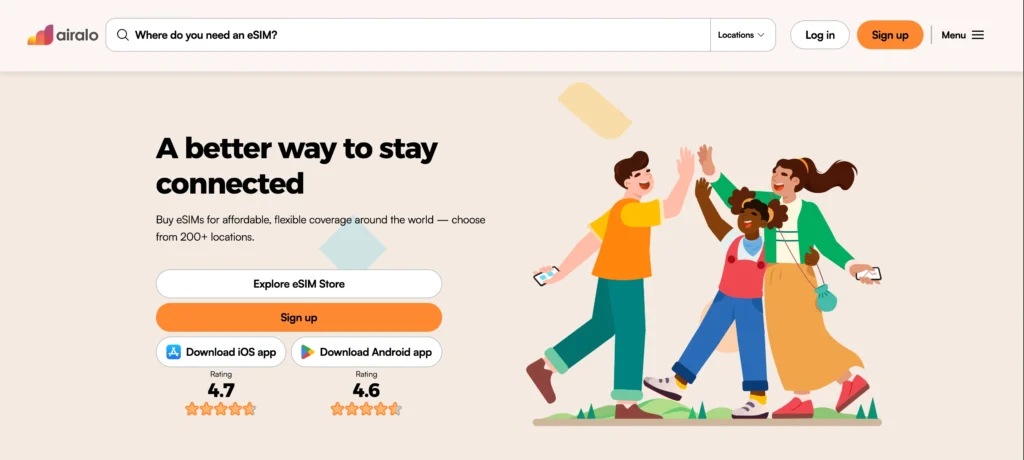
Airalo is one of the most recognisable names in the travel eSIM market, and it remains the safest starting point for most international travellers.
The platform offers local, regional, and global plans. You can buy an eSIM for a single country, select a regional option covering several nearby destinations, or use a Discover global package for a longer multi-country trip.
Its Discover global eSIM covers more than 100 countries, while Discover+ options can include data, calls, and text messages rather than data alone.
Airalo’s biggest advantage is balance.
It may not always offer the lowest price or the largest data allowance, but its app is polished, the selection is broad, and the purchase process is easy to understand.
Best for
- First-time eSIM users
- Multi-country holidays
- Frequent international travellers
- People who want one familiar app
- Travellers needing regional or global plans
The Standout Feature
Airalo offers one of the strongest selections of local, regional, and global eSIM plans in a single marketplace.
You do not need to create a new account with a different provider for every trip. Once the eSIM is installed, you can manage plans, check usage, and purchase supported top-ups through the app.
Regional plans are particularly useful for trips involving several countries.
For example, someone travelling through France, Spain, Italy, and Germany can buy one European package rather than install a separate eSIM for every destination.
Airalo also operates a rewards system that gives customers credit toward future purchases. This can provide modest value for frequent users, although it should not determine which plan you buy.
The Catch
Airalo’s quality can vary by destination.
The company is selling access through local and regional network partners, so an excellent experience in one country does not guarantee identical performance somewhere else.
Many plans are also data-only. You may not receive a local phone number for ordinary calls or SMS messages unless you select a package that specifically includes them.
Airalo is usually competitively priced, but bargain hunters can sometimes find more data for less money through Nomad, Saily, or a destination-specific provider.
Pros
- Large selection of country and regional plans
- Global eSIM options
- Beginner-friendly app
- Easy data tracking
- Top-ups available on supported plans
- Some packages include calls and texts
- Useful rewards for repeat customers
Cons
- Performance varies by local partner
- Many packages are data-only
- Not always the cheapest per gigabyte
- Some plans cannot be topped up
- Network details require careful checking
Price/Value Rating: 9.3/10
Pick Airalo when you want a reliable all-round platform with broad coverage and a simple app. It is the best default recommendation for travellers who do not want to research a different provider for every country.
2. Holafly: Best for Unlimited Data
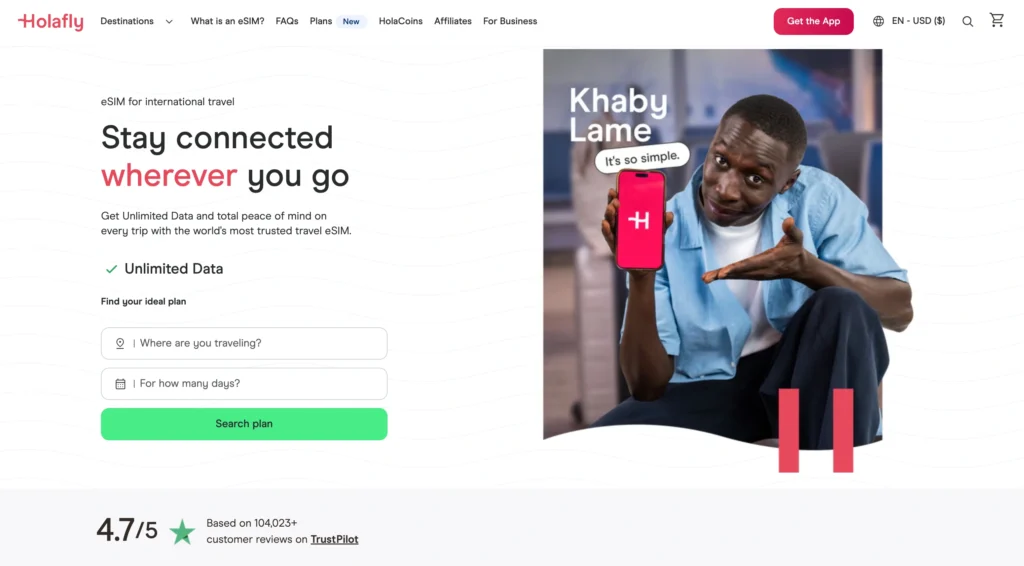
If you use a lot of mobile data, Holafly should be near the top of your list.
Holafly focuses heavily on unlimited-data packages across popular international destinations. Instead of worrying about whether 5GB will last for a week, you choose the destination and number of travel days.
This approach works well for people who regularly use navigation, social media, video streaming, cloud apps, or work platforms.
It is also easier to budget. You know the cost before travelling and do not need to keep checking how many gigabytes remain.
Best for
- Heavy data users
- Remote workers
- Social-media creators
- Travellers taking longer holidays
- People who do not want to monitor usage
The Standout Feature
Holafly makes unlimited international data easy to buy and understand.
Many destination plans let you select the exact number of days needed rather than forcing you into a standard 7-day or 30-day package.
The company offers unlimited-data plans across a wide range of popular destinations, with installation through a QR code and management through its website or app.
This flexibility is useful for unusual trip lengths. If you are travelling for 11 days, you can often purchase coverage for those 11 days rather than paying for a full month.
The Catch
Holafly can be expensive for light users.
Someone who needs only maps, WhatsApp, and occasional email may pay far less for a small fixed-data package from Airalo, Saily, or Nomad.
Unlimited also needs to be interpreted carefully.
The plan may be subject to local carrier policies, network management, or reduced speeds after heavy use. Hotspot sharing can be limited even when phone data is advertised as unlimited. Some destination plans allow only a set amount of tethering per day.
Most Holafly products are data-only. You will normally continue using internet-based calling apps rather than receive a standard local number.
Pros
- Unlimited-data options in many destinations
- Customisable trip duration
- Easy installation
- No need to monitor gigabytes
- Useful for streaming and remote work
- Round-the-clock customer assistance
- Strong coverage in popular tourist markets
Cons
- Expensive for light data users
- Hotspot usage may be restricted
- Fair-use rules can apply
- Mostly data-only plans
- Not every destination offers identical features
Price/Value Rating: 8.9/10
Pick Holafly when you genuinely use a lot of data and want predictable costs. Do not pay the unlimited-data premium when a small 3GB or 5GB package would comfortably cover your trip.
3. Nomad: Best for Affordable Fixed-Data Plans
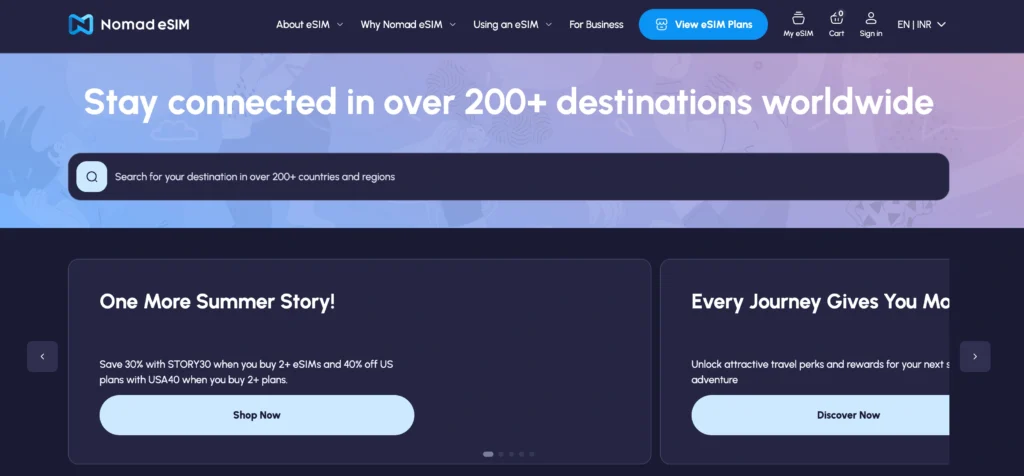
If you’re on a budget, look at Nomad.
Nomad offers prepaid data packages across more than 200 destinations, including country-specific, regional, and global options. Plans can be installed through the app or with a QR code, and the service supports hotspot sharing on many packages.
The platform often sits in the sweet spot between price and usability.
Its plans are generally easy to compare, and it frequently offers several data allowances for the same destination. This lets you choose a low-cost package for a short city break or a larger plan for a longer journey.
Best for
- Budget-conscious travellers
- Short international trips
- Backpackers
- Travellers who understand their data usage
- People who need hotspot support
The Standout Feature
Nomad often provides strong per-gigabyte value without making the app difficult to use.
Some bargain eSIM providers feel like wholesale marketplaces. The prices look attractive, but network details, installation instructions, and support channels can be unclear.
Nomad feels more polished.
The app guides users through setup, displays the plan’s validity and remaining data, and lets customers buy add-ons on eligible packages.
It is especially competitive for travel across Europe, Asia, and North America, though the best provider still varies by destination.
The Catch
Nomad does not offer the same plan structure everywhere.
One country may have several affordable local-network options, while another may have only a small selection or higher prices.
Many packages are data-only, and speeds depend on the network partner. Some unlimited plans may operate at a reduced speed after a defined amount of high-speed usage.
Nomad’s customer service is available through online channels, but travellers who prefer immediate phone support may find the system less reassuring than dealing with their home carrier.
Pros
- Competitive fixed-data pricing
- Coverage across a large number of destinations
- Local, regional, and global packages
- Simple app and installation process
- Hotspot sharing on many plans
- Add-ons available for eligible eSIMs
- Suitable for short and medium trips
Cons
- Plan quality differs by destination
- Mostly data-only packages
- Unlimited plans may have speed conditions
- Not every plan supports top-ups
- Limited traditional phone support
Price/Value Rating: 9.1/10
Pick Nomad when you know roughly how much data you need and want a competitive fixed-data package. It is one of the strongest alternatives to Airalo, particularly when its price per gigabyte is lower for your destination.
4. Saily: Best for Beginners and Security-Focused Travellers
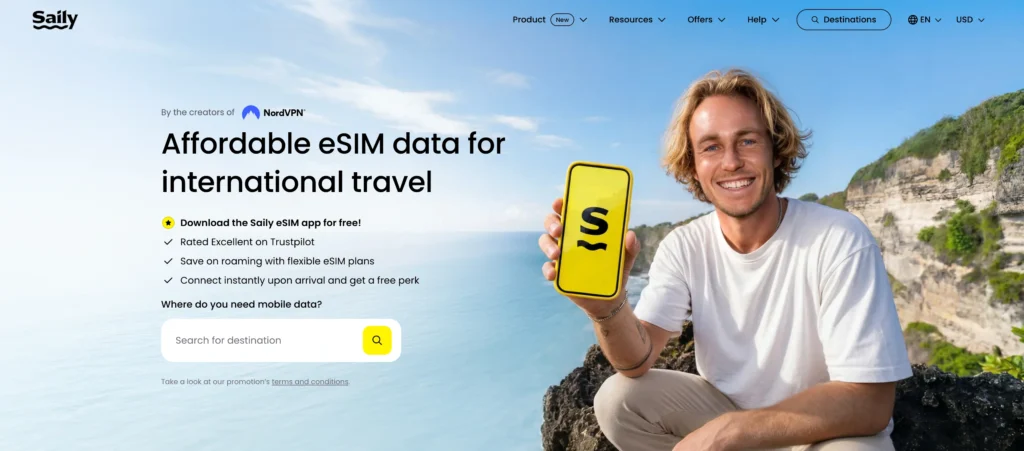
Saily is a travel eSIM service developed by the company behind NordVPN.
Its biggest strength is simplicity.
The app is designed for people who may never have installed an eSIM before. You choose a destination, purchase a plan, install the eSIM, and activate it when you arrive.
Saily offers destination-specific, regional, and global plans. Its global package currently covers more than 100 destinations, while individual plans commonly start with small, inexpensive data allowances.
Best for
- First-time eSIM users
- Security-conscious travellers
- Short holidays
- People who want a clean app
- Travellers needing small data packages
The Standout Feature
Saily combines easy setup with built-in security and privacy tools.
Depending on the plan and app version, users may have access to features designed to block malicious websites, reduce intrusive advertising, or change their virtual location.
That does not replace a full VPN for every use case, but it adds value for travellers regularly connecting through unfamiliar networks and websites.
Saily also allows hotspot sharing, subject to the selected plan’s data allowance and device support. Its destination plans frequently include small entry-level packages, making it practical for travellers who need only basic connectivity.
The Catch
Saily is newer than Airalo and some of the older travel-connectivity brands.
Its coverage is broad, but experienced travellers may find that Airalo or Nomad offers more plan variations in certain countries.
Most packages are data-only. You should not assume you will receive a phone number for local calls or SMS verification.
The lowest-priced plans also provide very little data. A 1GB package may look cheap, but it can disappear quickly if background backups, app updates, or video autoplay remain enabled.
Pros
- Very simple app
- Beginner-friendly installation
- Affordable small-data packages
- Security-focused features
- Regional and global options
- Hotspot support
- Round-the-clock chat assistance
Cons
- Newer provider with a shorter track record
- Mostly data-only
- Fewer plan choices in some destinations
- Small packages can run out quickly
- Advanced features may not matter to every traveller
Price/Value Rating: 9.0/10
Pick Saily when ease of use matters more than having the largest possible plan selection. It is particularly suitable for first-time eSIM buyers who want clear setup instructions and a clean app.
5. Ubigi: Best for Connected Devices and Frequent Travellers
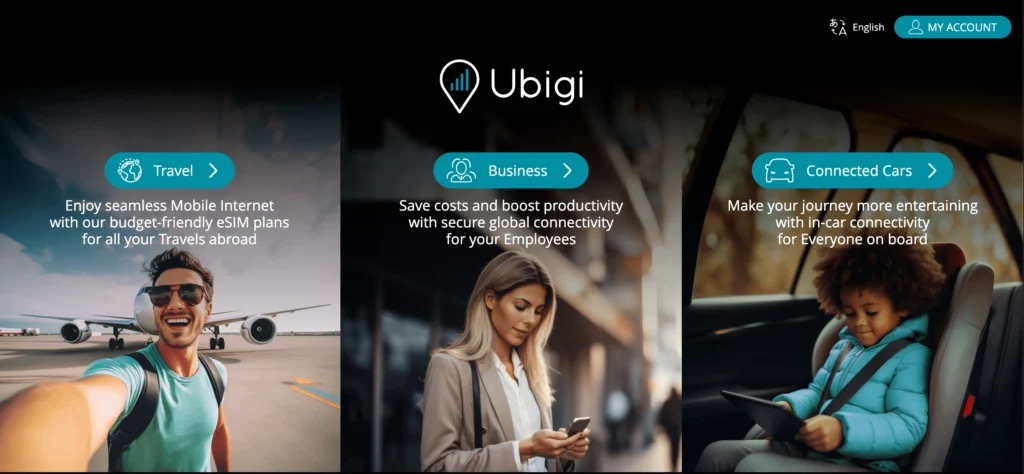
Ubigi is a strong option for travellers who use more than just a smartphone.
Its data services support compatible phones, tablets, laptops, and connected vehicles. The company offers prepaid eSIM plans across more than 200 destinations, with packages ranging from small fixed allowances to larger and unlimited options in selected markets.
Ubigi is especially popular among travellers who regularly visit Europe, Japan, North America, and other major business or tourism markets.
The service is managed through an app, where users can purchase plans, monitor consumption, and add data.
Best for
- Frequent international travellers
- Tablet and laptop users
- Business travellers
- Visitors to Japan and Europe
- People needing recurring data plans
The Standout Feature
Ubigi works well across a wider range of connected devices than many travel-focused eSIM apps.
Some newer laptops and tablets have built-in cellular eSIM support. Ubigi lets users buy data directly for those devices without tethering through a phone.
That can be useful for business travellers who need a reliable connection for work but do not want to depend on hotel Wi-Fi.
Ubigi also offers recurring packages in selected destinations. These may suit frequent travellers, overseas students, or people splitting their time between countries.
The Catch
Ubigi’s plan catalogue can feel less intuitive than the cleaner interfaces offered by Saily or Airalo.
Prices and available packages vary considerably by destination. Some countries have excellent-value options, while others are less competitive.
Most plans provide mobile data only. Calls and standard SMS messages are generally handled through your existing SIM or internet-based apps.
You also need to install and configure the Ubigi profile correctly before relying on it. Travellers should complete the setup while they still have stable Wi-Fi rather than waiting until after landing.
Pros
- Works on compatible phones, tablets, and laptops
- Coverage across more than 200 destinations
- Strong options in several major travel markets
- Recurring plans in selected locations
- Data top-ups through the app
- Hotspot and tethering support
- Useful for business travellers
Cons
- Plan selection can feel complicated
- Pricing varies widely by country
- Mostly data-only
- Not always the cheapest option
- Setup may feel less intuitive for beginners
Price/Value Rating: 8.8/10
Pick Ubigi when you need data for a tablet, cellular laptop, or multiple international trips. For a straightforward one-week holiday using only a phone, Airalo, Nomad, or Saily may offer an easier experience.
6. GigSky: Best for Cruises, Flights, and Offshore Connectivity
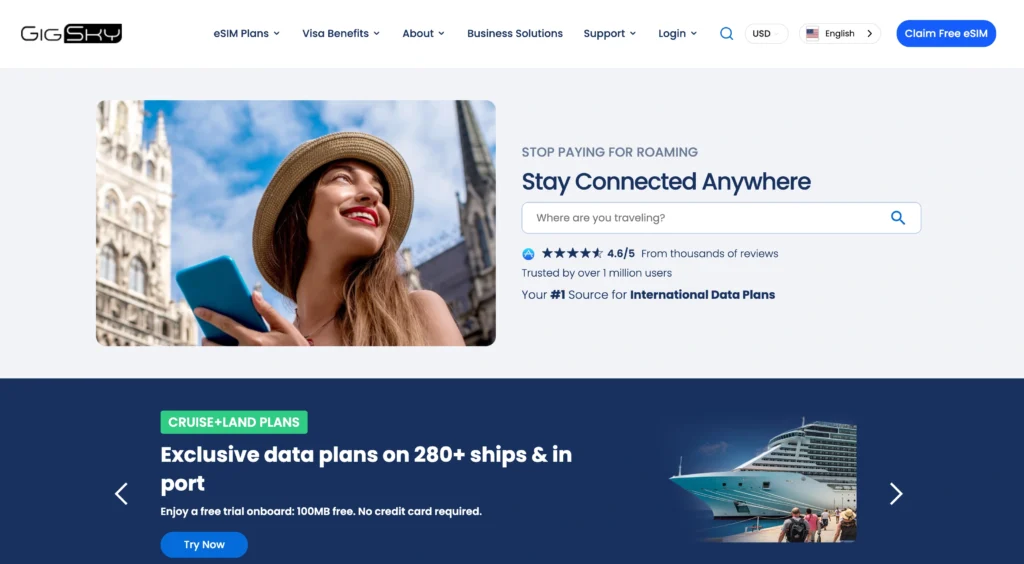
GigSky is one of the more specialised options among the best eSIMs for international travel.
Most travel eSIM companies focus on mobile coverage after you arrive in another country. GigSky goes further by offering plans for international destinations, cruise ships, offshore use, and selected in-flight networks.
That makes it particularly useful for travellers who spend part of their journey away from normal land-based mobile coverage.
GigSky says its service reaches more than 200 countries and regions, over 200 cruise ships, and selected airlines through hundreds of network partners. New customers can also access a small free trial plan in supported destinations, which gives them a chance to test installation and connectivity before purchasing a larger package.
Best for
- Cruise passengers
- Frequent business travellers
- People travelling between several countries
- Travellers needing offshore connectivity
- Users who want to test an eSIM before paying
The Standout Feature
GigSky offers connectivity in places where ordinary travel eSIMs may stop working.
Its cruise packages are the main reason to consider it over Airalo, Nomad, or Saily. Cruise passengers commonly face very expensive ship Wi-Fi packages and limited mobile coverage once the vessel leaves port.
GigSky offers cruise-and-land and sea-focused plans for selected ships and routes. This can allow travellers to continue using mobile data at sea without depending entirely on the cruise company’s internet package. Coverage still depends on the ship and route, so compatibility must be checked before purchasing.
The provider also offers international subscription products for frequent travellers. Supported plans can connect automatically to available partner networks as users move between countries.
Hotspot use is allowed on its subscription and unlimited-data products, making GigSky useful for travellers connecting a laptop or tablet.
The Catch
GigSky is not usually the cheapest choice for an ordinary city holiday.
A traveller spending seven days in Paris or Bangkok may find better fixed-data pricing from Nomad, Saily, Airalo, or Jetpac. GigSky’s strongest features matter more when you are travelling at sea, crossing several borders, or using multiple devices.
Activation timing also deserves attention. Certain regional, world, or cruise plans may begin when the eSIM is installed if the current location is already included in the plan. Installing too early could reduce the remaining validity period.
Cruise coverage is not the same as uninterrupted satellite internet. Signal quality can depend on the ship, route, location, network availability, weather, and onboard infrastructure.
Pros
- Coverage in more than 200 destinations
- Cruise and offshore data plans
- Selected in-flight connectivity
- Free trial data for new customers
- Hotspot support
- Unlimited-data options
- Useful recurring subscriptions
Cons
- Often expensive for normal city trips
- Cruise support varies by ship and route
- Some plans may activate during installation
- Mostly focused on mobile data
- Plan selection can feel complicated
Price/Value Rating: 8.7/10
Pick GigSky when your journey includes a cruise, offshore travel, or frequent movement between countries. For a basic one-country holiday, compare its price with Nomad and Airalo before buying.
7. aloSIM: Best for Travellers Who Need a Phone Number
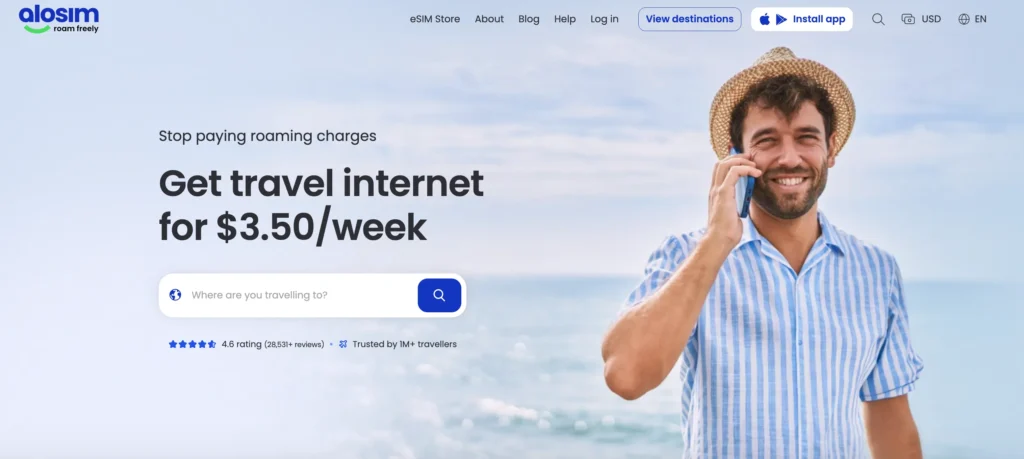
Most international travel eSIMs provide data but no traditional phone number.
aloSIM takes a different approach. Its travel plans include access to an international number through Hushed, its sister calling and messaging app. This gives travellers a way to make calls, send texts, and receive messages using mobile data or Wi-Fi.
The eSIM itself remains primarily a data service. The phone number operates through the Hushed app rather than functioning as a standard local mobile number attached directly to the eSIM.
aloSIM sells prepaid plans for more than 200 countries and regions, along with regional packages for multi-country travel.
Best for
- Travellers who need calls and texts
- People making restaurant reservations
- Business travellers
- Longer international trips
- Travellers who prefer fixed-data plans
The Standout Feature
Every aloSIM plan includes access to an international phone number through Hushed.
This can be more practical than relying entirely on WhatsApp or FaceTime.
A phone number may help when contacting restaurants, tour companies, accommodation hosts, local businesses, or people who do not use the same messaging apps. It also lets travellers keep their primary number more private when communicating with temporary contacts.
Because the number uses an app, calling and messaging consume internet data rather than traditional mobile minutes. The service can work over the aloSIM connection or Wi-Fi.
The provider’s destination pages are easy to understand, and the packages usually state the data amount, validity, supported network, and expected connection type.
Hotspot sharing is available on supported devices, making aloSIM practical for connecting a laptop during shorter work sessions.
The Catch
The included number is not necessarily a local number for the country you are visiting.
It may not work for every verification code, banking service, ride-hailing app, or website that requires a local mobile number. Some services block virtual or internet-based numbers.
Travellers also need to manage two connected products: aloSIM for mobile data and Hushed for the phone number. It is not as seamless as buying a conventional local SIM that includes data, calls, texts, and a domestic number in one package.
Calling consumes data, and international calling conditions may vary according to the number, destination, and Hushed plan.
You must also correctly configure your primary SIM to avoid accidental roaming charges. Leaving your home SIM active for calls or SMS can trigger a daily international roaming plan with some mobile carriers.
Pros
- Plans for more than 200 destinations
- International phone number included
- Calling and texting through Hushed
- Regional eSIM packages
- Transparent prepaid pricing
- Hotspot support
- Straightforward installation
Cons
- Phone number works through a separate app
- Number may not be local to the destination
- May not receive every verification code
- Calling uses internet data
- Mostly fixed-data rather than unlimited plans
Price/Value Rating: 8.9/10
Pick aloSIM when calls and texts matter but you do not need a true local mobile number. It offers more communication flexibility than most data-only travel eSIMs.
8. Jetpac: Best for Budget Data and Flight-Delay Benefits
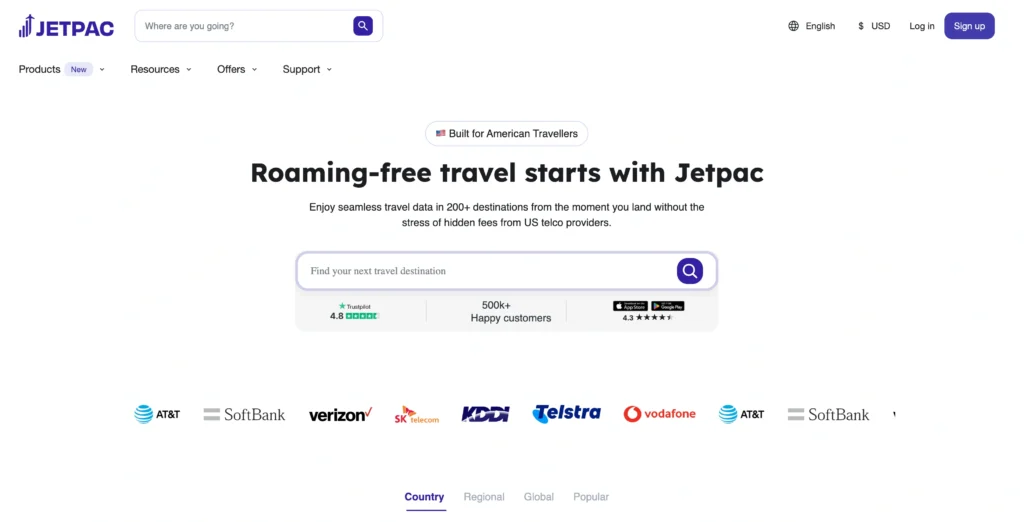
Jetpac is a travel eSIM provider with a slightly different selling point.
Along with prepaid international data, eligible Jetpac customers can register a flight for its SmartDelay benefit. When a registered flight suffers a qualifying delay or cancellation, the traveller may receive a LoungeKey voucher for airport lounge access.
That does not improve mobile coverage, but it is one of the more useful travel perks offered by an eSIM company.
Jetpac provides data packages across more than 200 destinations. Once its eSIM profile has been installed, users can add another plan for future trips instead of downloading a completely new eSIM each time.
Best for
- Budget travellers
- Frequent flyers
- Travellers worried about flight delays
- Short international holidays
- People visiting several countries
The Standout Feature
Jetpac combines affordable travel data with a conditional airport-lounge benefit.
Eligible travellers register their flight before departure. When the airline announces a delay that meets the required threshold, or the flight is cancelled under qualifying circumstances, Jetpac can issue a LoungeKey voucher for use at an available airport lounge.
This could provide food, seating, charging points, Wi-Fi, and a quieter place to wait.
Jetpac also tends to market low-cost introductory data packages, making it appealing to travellers who need only light connectivity for maps, messaging, and transport apps.
The same installed eSIM can be reused by purchasing a new package before a later trip, reducing the need to repeatedly add and remove profiles.
The Catch
The lounge benefit has conditions.
You must register the eligible flight correctly and before the required deadline. The delay must meet Jetpac’s qualifying threshold, and lounge access depends on LoungeKey availability at that airport.
A delayed flight does not automatically guarantee entry. Certain delay causes, flight changes, airport limitations, or registration issues may prevent the benefit from being issued.
The lounge voucher should therefore be treated as a useful extra, not the main reason to buy the eSIM.
Jetpac’s cheapest packages may also contain very little data. They are excellent for light use but unsuitable for video streaming, constant social-media uploads, or remote work.
As with other travel eSIMs, network quality depends on the local partner and destination.
Pros
- Coverage in more than 200 destinations
- Competitive entry-level plans
- Flight-delay lounge benefit
- Reusable eSIM profile
- Regional and multi-country options
- Simple digital setup
- Good for short trips
Cons
- Lounge access has strict conditions
- Cheapest plans have limited data
- Mostly data-only service
- Network performance varies by country
- Not designed primarily for heavy users
Price/Value Rating: 8.8/10
Pick Jetpac when you want an affordable data package and regularly travel by air. The lounge feature is a valuable bonus, but confirm all SmartDelay conditions before depending on it.
Quick Comparison of the Top 5 International Travel eSIMs
| Provider | Best For | Main Strength | Biggest Weakness | Value Rating |
|---|---|---|---|---|
| Airalo | Most international travellers | Wide selection of local, regional, and global plans | Performance varies by network partner | 9.3/10 |
| Nomad | Affordable fixed data | Strong price per gigabyte | Plan quality varies by destination | 9.1/10 |
| Saily | Beginners | Simple app with security features | Fewer plan variations in some countries | 9.0/10 |
| Holafly | Heavy data users | Unlimited-data plans | Expensive for light usage | 8.9/10 |
| aloSIM | Calls and texts | Includes an app-based international number | Number is not always local | 8.9/10 |
These rankings should not be treated as universal.
Airalo may be the most balanced global provider, but Nomad could offer a better price for your destination. Holafly may be expensive for someone using only 2GB, yet excellent value for a remote worker consuming 30GB.
The local network partner matters as much as the brand name.
Frequently Asked Questions About International Travel eSIMs
What is an eSIM, and how does it work abroad?
An eSIM is a digital mobile profile installed on a compatible phone, tablet, or laptop.
Instead of inserting a physical SIM card, you download the provider’s profile using an app, QR code, or manual installation details. After arriving at your destination, the eSIM connects to one of its supported local mobile networks.
You normally set the travel eSIM as your mobile-data line while keeping your primary SIM available for calls or messages.
Are international eSIMs cheaper than roaming?
They are usually cheaper than standard international roaming, particularly when your home carrier charges a daily roaming fee.
A prepaid eSIM lets you choose a specific amount of data and validity period. This provides better cost control because the plan will stop working or require a top-up when the allowance ends.
Still, compare it with your carrier’s travel package. Some premium mobile plans already include international roaming.
Can I keep WhatsApp when using a travel eSIM?
Yes.
WhatsApp normally remains linked to your existing phone number even when mobile data comes from another eSIM. You do not need to change your WhatsApp number simply because you installed a travel data plan.
When WhatsApp asks whether you want to update the registered number, keep the existing one unless you genuinely want to move the account.
Can I receive bank OTPs on my regular number?
Usually, provided your primary SIM remains active and your carrier supports receiving SMS abroad.
Receiving a message may be free, but making calls, answering calls, or sending texts could trigger roaming charges. Carrier policies vary.
Keep mobile-data roaming switched off for your primary SIM. Set the travel eSIM as the only line used for cellular data.
Do travel eSIMs include calls and SMS?
Most are data-only.
You can use WhatsApp, FaceTime, Signal, Telegram, Google Meet, or other internet-based apps. Airalo has selected Discover+ plans with calls and texts, while aloSIM includes access to an international number through the Hushed app.
Buy a local operator eSIM or physical SIM when you specifically need a domestic mobile number.
How much data do I need for an international trip?
Light users may need around 1GB to 3GB per week for maps, email, messaging, and occasional browsing.
Moderate users may use 5GB to 10GB through social media, music, regular browsing, and some video.
Heavy users, remote workers, and content creators may need 20GB or more. Video streaming, cloud backups, video calls, and hotspot use consume data quickly.
Disable automatic app updates and photo backups before travelling.
Should I install my eSIM before leaving home?
Yes, but check when the plan’s validity begins.
Some eSIMs activate only when they connect to a supported destination network. Others may activate when installed or when manually switched on.
Install the profile while you have stable Wi-Fi, but leave the travel line turned off until the correct activation time.
Keep the QR code and installation details somewhere accessible offline.
Can I use an eSIM as a personal hotspot?
Many providers allow tethering, but rules vary.
Nomad, Saily, Ubigi, aloSIM, and GigSky support hotspot use on many plans. Unlimited packages may impose a separate tethering limit even when phone data is described as unlimited.
Check the individual destination plan rather than relying on the provider’s general marketing page.
Final Verdict: Which International Travel eSIM Should You Pick?
The best eSIM for international travel is the one that fits your destination and data habits.
Do not buy entirely based on provider reputation. Open the plan details and check the local partner network, data amount, validity, tethering policy, and activation rules.
The Overall Winner: Airalo
Airalo offers the strongest balance of coverage, app quality, regional plans, global options, and beginner-friendly management.
It is not guaranteed to be the cheapest in every country, but it is the easiest general recommendation for travellers who want one dependable eSIM marketplace.
The Budget Winner: Nomad
Nomad is the better pick when price per gigabyte matters.
Its fixed-data packages are often competitive, and the app is polished enough that you do not feel as though you are buying from an unknown wholesale provider.
Compare Nomad and Airalo directly for your destination before paying.
The Unlimited-Data Winner: Holafly
Holafly is designed for travellers who do not want to count gigabytes.
It is a sensible option for remote workers, heavy social-media users, and people streaming video abroad. Light users should avoid paying its higher unlimited-data price.
The Best for Beginners: Saily
Saily has one of the cleanest setup experiences.
Its security-related extras and straightforward app make it a strong choice for travellers using an eSIM for the first time.
The Best for Cruises: GigSky
GigSky wins for specialised connectivity.
Its cruise, offshore, and selected in-flight products cover situations where a standard country eSIM may be useless. It is less compelling for an ordinary city break.
The Best for Calls and Texts: aloSIM
aloSIM is the most practical option here for travellers who want more than mobile data.
The included Hushed number can help with calls and texts, although it should not be confused with a normal local cellular number.
The Best for Frequent Flyers: Jetpac
Jetpac combines budget-friendly data with a useful flight-delay benefit.
The SmartDelay lounge voucher will not apply to every disruption, but it gives the service a travel perk that most competing eSIMs do not offer.
The Best for Multiple Devices: Ubigi
Ubigi is well suited to compatible tablets, laptops, and connected devices.
It is particularly useful for business travellers who want independent mobile data on a laptop rather than relying entirely on phone tethering.
The smartest approach is to compare at least three providers for the exact country you are visiting.
Choose Airalo for overall reliability, Nomad for fixed-data value, and Holafly for unlimited use. Check GigSky for cruises, aloSIM when you need a number, and Jetpac when its flight-delay benefit is useful.
Buy and install the eSIM before leaving home, but verify the activation policy. Keep your primary line’s data roaming switched off, download offline maps, and save the provider’s troubleshooting instructions.
That preparation matters more than saving one or two dollars on the plan.